Most advice on how to encourage children to read is really advice on how to make them look like they are reading. Sticker charts. Reading logs signed at 9pm. A bedtime deal negotiated like a hostage release. It produces compliance, and compliance is not the same animal as a reader.
I want to give you the opposite: the small number of things the evidence actually supports, and the one thing you should probably stop doing tomorrow.
The Numbers Went Up This Year and Are Still Grim
The National Literacy Trust’s 2026 survey reached 125,375 children aged five to eighteen. Among the eight to eighteens, just over one in three, 36.1 per cent, said they enjoy reading in their free time, and only 20.3 per cent read something daily.
The good news is that both figures rose for the first time in five years, after hitting a twenty year low in 2025. The sobering part is the comparison: in 2016 the same age group reported 58.6 per cent enjoyment and 32 per cent daily reading. A decade has been lost, and one decent year does not get it back.
So if attempts to encourage children to read feel like swimming against a current in your house, that is because you are. This is not a parenting failure. It is a generational shift, and it responds to different tools than the ones your parents used on you. Schools vary enormously in how seriously they take it, incidentally, and parents comparing the Top 10 Schools in Dubai will ask about exam results long before they ask what happens in the library.
Reading Aloud Is the Highest Leverage Thing You Do
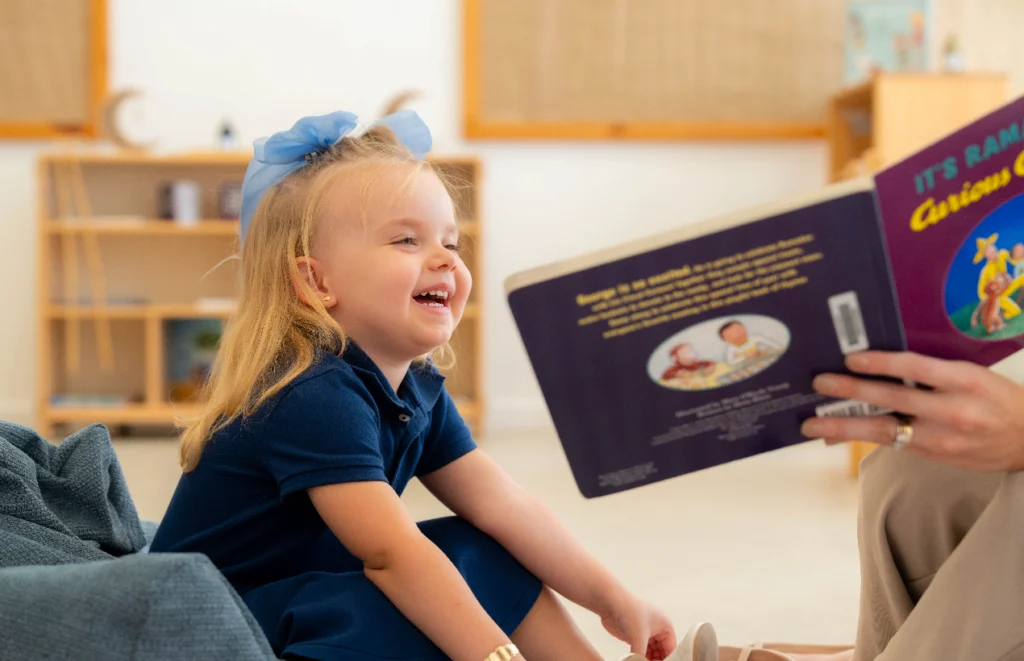
If you take one thing from this article, take this. A 2019 Ohio State study led by Jessica Logan modelled how many words children hear from books before they turn five, based on the word counts of sixty popular children’s titles:
- Never read to: 4,662 words
- One to two times a week: 63,570 words
- Three to five times a week: 169,520 words
- Daily: 296,660 words
- Five books a day: 1,483,300 words
Logan called the gap between the top and bottom of that list the million word gap. Look at the jump between never and daily. One short book. Ten minutes. Nearly 290,000 words.
The mechanism matters too: books use words that conversation does not. Nobody says “enormous” or “burrow” over breakfast. Anyone hoping to encourage children to read independently later is really buying vocabulary now.
The Caveat Logan Herself Gives
I am not going to oversell it. Those figures are a model, not a measurement of real households. Logan was also careful to separate her finding from the famous 1992 claim that poorer children hear thirty million fewer words by age three, noting that later research suggests that gap may be far smaller or absent entirely.
Treat the numbers as direction, not gospel. The direction is unambiguous.
Stop Trying to Improve Them
Here is where most parents go wrong, and where the data is refreshingly blunt. Efforts to encourage children to read usually begin with an adult deciding what is worth reading, which is roughly where they end.
The Literacy Trust found that 38.1 per cent of children were motivated to read when the material connected to a favourite film or television series. Its 2026 report goes further and says plainly that aligning reading with what a child already loves is the route back in. Even children who say they do not enjoy reading still choose song lyrics, news articles, comics and fan fiction.
Read that list again. Not one of those is what you had in mind. Which is precisely the point.
What Counts as Reading
Comics count. Graphic novels count. The football annual counts. The wiki about a video game counts. Print is not dead either: in 2025 roughly half of children still read fiction in print each month and two in five read non fiction.
If your child will read four hundred pages about Minecraft and nothing else, you have a reader. Whether the school agrees is the real question. A Dubai British School whose library lets a nine year old borrow whatever they like is doing more for reading than any facility on the tour, and it costs nothing.
The Thing That Quietly Kills It
Surveillance. Levels, logs, quizzes, the parental signature, the questions at the end.
Every one of those converts reading from a pleasure into a task with an assessor attached, and no adult would keep a hobby under those conditions. I am not against levelled books as a teaching tool. I am against them following a child home and eating the only part of reading that was ever theirs. A school that runs a structured reading scheme and still lets children choose freely is doing something harder and better than one that levels everything.
The best way to encourage children to read is to remove the audience.
Frequently Asked Questions
How do I get my child to read more?
Follow the interest rather than the reading list. National Literacy Trust data shows that nearly two in five children are motivated to read when the material connects to a film or series they already love. Read aloud past the age it feels necessary, keep books where they are trippable over, let them abandon anything boring, and let them see you read something you chose. Attempts to encourage children to read collapse when reading becomes another instruction from an adult, which is also why the school’s attitude matters more than its book list, an argument Why the scholars sets out.
At what age should children start reading?
Being read to should start as early as you like; the word exposure data covers birth to five. Reading independently varies enormously between children, and the pace is not a verdict on anything. What is consistent is that the word exposure from daily shared reading accumulates long before formal reading begins, which is why parents who want to encourage children to read should worry far more about the bedtime story than about the starting date.
How does reading help at school?
Through vocabulary, mainly, which is the quiet reason to encourage children to read at all. Children’s books carry words that everyday speech does not, and a child who has met “enormous” in a story recognises it in a science paper. Interestingly, even children who report low reading enjoyment know this: nearly half told the Literacy Trust that reading helps them learn new words or new things. They are not unconvinced of the value. They are unconvinced of the experience.
The Only Tip That Has Ever Worked in My House
Let them see you reading, and let them choose.
That is genuinely it. Children copy what adults do rather than what adults recommend, and a parent scrolling while telling a nine year old to read a book is making an argument the child can see straight through. Everything else, all the practical machinery of how to encourage children to read, is decoration on those two things.
Buy the ridiculous comic. Read the same story for the ninetieth night. Say nothing when they abandon the classic. And if you want a school that treats reading as a pleasure to be protected rather than a metric to be logged, the list of Admission open schools in Dubai shows where places remain.